
 Add Myanas as a Preferred Source
Nvidia unveils Nvidia RTX Spark at Computex 2026. The new AI superchip promises local AI agents, 1-petaflop performance, and Windows PCs from Dell, HP, and Microsoft.
Nvidia Just Changed the PC Game With RTX Spark (Again)
Nvidia founder and CEO Jensen Huang took the stage at Computex 2026 in Taipei with a theatrical spark literally and announced a device that could finally bring powerful, secure AI agents to regular Windows laptops. The chip is called RTX Spark, and it’s Nvidia’s latest attempt to crack the PC market after more than a decade of trying.
As of June 2026, Nvidia has officially announced RTX Spark, but no independent benchmarks or final pricing have been released. The following information is based on Nvidia’s announcement, partner disclosures, and early Computex 2026 reporting.
Here’s what we actually know, what’s still speculation, and why this matters for anyone who’s been waiting for an AI PC that doesn’t feel like a science experiment.
What Is RTX Spark? The Short Version
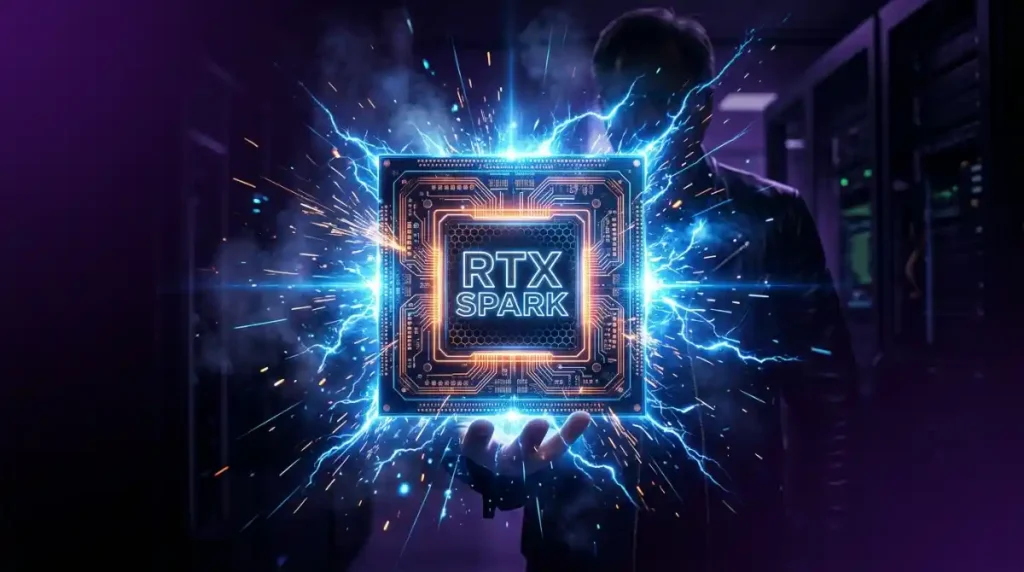
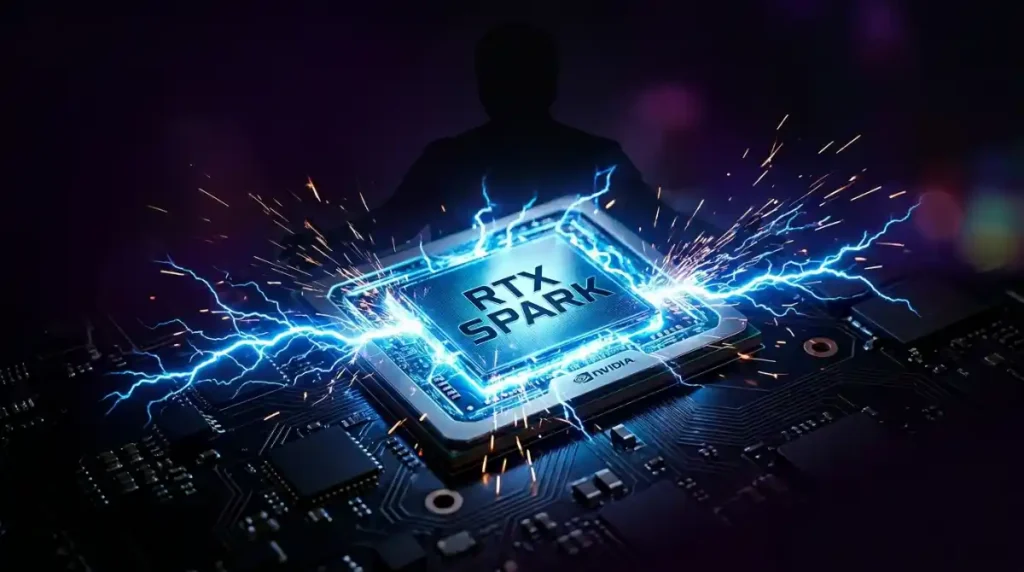
RTX Spark is a “superchip” Nvidia’s term for bundling multiple components into one package. It combines a 20-core Arm-based Grace CPU with a Blackwell-generation RTX GPU that includes 6,144 CUDA cores. The whole thing is built on TSMC’s 3-nanometer manufacturing process and packs about 70 billion transistors.
READ MORE
The headline number: 1 petaflop of AI computing power. That’s 1,000 trillion operations per second, running locally on your laptop without sending data to the cloud.
The chip also includes up to 128GB of unified LPDDR5X memory. For comparison, most current Windows laptops ship with 16GB or 32GB. This isn’t a small bump it’s a completely different category of machine.
Who’s Building RTX Spark PCs (And When)
Nvidia named an extensive list of partners during the announcement. Here’s the confirmed lineup for fall 2026: ASUS, Dell, HP, Lenovo, Microsoft Surface, and MSI will all ship RTX Spark devices first. Acer and Gigabyte will follow later.
Specific models already announced include:
Microsoft Surface Laptop Ultra Microsoft’s flagship RTX Spark device, which the company is calling “the most powerful Surface Laptop ever built.” It features a 15-inch mini-LED PixelSense touch display and will come in Platinum and Nightfall finishes.
ASUS ProArt P14 and P16 Professional creator laptops with OLED displays, 120Hz refresh rates, and sub-0.55-inch thickness.
Dell XPS 16 Creator Edition Few details yet, but Dell confirmed a tandem OLED screen with True Black HDR 600 support.
HP OmniBook X 14 and OmniBook Ultra 16 HP claims these will be “the world’s thinnest RTX Spark products,” though at 0.53 and 0.62 inches respectively, ASUS has them beat.
Lenovo Yoga Pro 9n Lenovo hasn’t shared much, but the previous Yoga Pro 9i delivered over 15 hours of battery life, so expectations are high.
MSI Prestige N16 Flip AI+ The first 2-in-1 convertible with RTX Spark, featuring a 16-inch tandem OLED display.
The AI Agent Pitch That Actually Makes Sense
Here’s where Nvidia’s strategy diverges from every previous Windows on Arm attempt. Jensen Huang put it this way: “For forty years, you launched apps. Click. Type. With RTX Spark and Microsoft Windows, you ask and the PC does the work.
READ MORE
Translation: Instead of opening Excel and manually building a forecast, you’d theoretically tell your PC “forecast next quarter’s sales” and an AI agent would handle the spreadsheet, analysis, and presentation.
Nvidia specifically mentioned two AI agent platforms: OpenClaw and Hermes Agent. These aren’t consumer brands yet they’re development frameworks for building autonomous AI agents. Think of them as the operating system for AI that can actually do things, not just chat.
The security piece matters more than most articles are acknowledging. Nvidia and Microsoft jointly developed secure “sandboxes” to run these agents. That means the AI can access your files and tools without having free reign over your entire system. It’s a genuine attempt to solve the “do I really want an AI poking around my documents?” problem.
The $200 Billion Bet
Here’s what Huang told investors on Nvidia’s May earnings call: “We’ll have billions of agents, and those billions of agents will all use tools. And those tools are going to be like PCs, just like us humans using PCs today. We’re going to need a lot more CPUs.”
This isn’t small thinking. Huang said he’s identified a $200 billion market for Nvidia selling CPUs specifically for AI workloads, on top of their existing GPU business. The company’s Vera server CPU announced earlier this year has already generated $20 billion in sales.
RTX Spark is the consumer-facing version of that server technology. It’s Nvidia’s attempt to bring data-center AI capabilities to a laptop you can buy at Best Buy.
The Elephant in the Room: Nvidia Has Failed at This Before
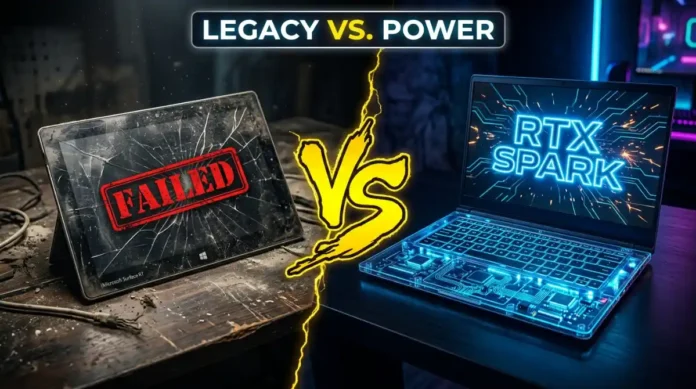
Let’s be direct about history. In 2012, Microsoft launched the Surface RT with an Nvidia Tegra 3 chip inside. It was an Arm-based Windows device that promised good battery life and a sleek design. Within a year, Microsoft took a $900 million write-down on unsold inventory. Dell and other partners abandoned their versions entirely.
READ MORE
The problem wasn’t just the chip it was the software ecosystem. Windows RT couldn’t run traditional x86 desktop applications. Users bought what looked like a laptop and got something that behaved more like a restricted tablet.
Fast forward to 2026, and the landscape looks completely different. Microsoft’s Prism emulator has matured significantly, now supporting AVX2 instructions that many games and professional apps require. Adobe is optimizing Photoshop and Premiere Pro specifically for RTX Spark, promising double the AI and graphics performance on native Arm code.
I spent some time looking at the announcement specs and partner list, and one thing jumped out at me: Adobe, Blender, ComfyUI, Riot Games, and Xbox are all signed on as software supporters. That’s not a token list. Those are serious creative and gaming workloads. If RTX Spark runs League of Legends natively and renders 4K video in Premiere without breaking a sweat, that addresses exactly what killed the Surface RT.
What We Still Don’t Know (And Nvidia Won’t Say)
The silence on certain topics is louder than the announcements.
Pricing remains completely unconfirmed. The most relevant comparison is Nvidia’s DGX Spark mini-computer, which uses similar GB10 silicon and currently sells for around $4,800. That’s an enterprise developer device. Consumer laptops will likely cost less though early reports suggest $2,000 to $3,000 for the first wave of RTX Spark machines.
For perspective, the Mac Mini that many developers use for running OpenClaw costs $599 to $1,299 depending on configuration. Apple’s M-series MacBooks range from $999 to $3,500. If RTX Spark laptops launch at $2,500 minimum, that’s a premium product, not a mass-market device.
Battery life claims are vague. Several partners promise “all-day battery life” without specifying hours. Given that RTX Spark packs server-class components into a laptop chassis, real-world battery performance is a genuine question mark.
Game compatibility hasn’t been demonstrated. Nvidia says RTX Spark can run AAA games at 1440p and over 100 frames per second. But which games? Steam’s library is almost entirely x86 code that would need emulation on Arm. Anti-cheat systems notoriously sensitive to emulation have been a specific pain point for Windows on Arm. Nvidia says it’s working with anti-cheat providers, but there’s no public confirmation of which games actually work.
CPU performance benchmarks are absent. Nvidia claims the Grace CPU is “competitive” with x86 alternatives but hasn’t released any comparative data against Intel Core Ultra, AMD Ryzen, or Apple M-series chips. When a journalist asked an Nvidia spokesperson why RTX Spark would succeed where Copilot+ PCs disappointed, the response was: “I leave that to your judgment.” That’s not confidence that’s deflection.
The Competition Isn’t Standing Still
Even if RTX Spark delivers on every promise, Nvidia enters a crowded field.
Apple’s M-series chips have owned the high-performance Arm laptop market since 2020. The MacBook Pro with M4 is widely considered the best creative laptop available. And Apple’s developer ecosystem is fully transitioned to Arm a process that took them three years and significant developer pressure.
Qualcomm’s Snapdragon X Elite powers the current generation of Copilot+ PCs. While early reviews praised battery life, graphics performance and game compatibility were genuine weak points. Some Copilot+ models were labeled “frequently returned” on Amazon, and Microsoft’s flagship Recall feature had to be pulled for privacy concerns.
Intel and AMD aren’t going away either. Both companies are integrating NPUs (neural processing units) into their x86 chips. You don’t need an Arm chip to run AI workloads you need enough raw compute and memory bandwidth. Intel’s Lunar Lake and AMD’s Strix Point both claim significant AI improvements in 2025-2026 laptops.
So Should You Wait for RTX Spark?
If you need a laptop in the next three months, buy something that exists today. The first RTX Spark devices arrive in fall 2026, and initial supply will almost certainly be limited.
If you’re a developer, creative professional, or serious AI hobbyist and you can wait until late 2026, RTX Spark is worth watching. The combination of unified memory, Nvidia’s CUDA ecosystem, and local 1-petaflop AI performance is genuinely unique in the Windows laptop market. No one else is offering 128GB of unified memory in a portable form factor.
If you’re a regular user who mostly browses the web, uses Office, and plays a few games wait for reviews. RTX Spark is overkill for your needs, and you’ll pay a premium for performance you won’t use. A standard Intel or AMD laptop with 16GB of RAM will serve you fine for half the price.
The Bottom Line
Nvidia’s RTX Spark is the most serious attempt at Windows on Arm since Microsoft wrote off nearly a billion dollars on the Surface RT. The technology has matured dramatically in 14 years. The software ecosystem is finally getting native Arm support from major players like Adobe. And the AI agent pitch secure, local, powerful actually makes sense for the first time.
But Nvidia hasn’t shown its hand on pricing, battery life, or real-world game compatibility. The company is asking us to trust based on a keynote presentation and some non-functional prototypes at Computex.
Here’s my honest take: Jensen Huang has earned the benefit of the doubt. Nvidia’s track record over the last five years from data-center dominance to the RTX graphics revolution suggests they know what they’re doing. But PC history is littered with great chips that failed because of software, pricing, or bad timing.
The RTX Spark will likely be a fantastic device for a specific type of user: developers and creators who need local AI power and are willing to pay $2,500 or more for it. Whether it becomes the “M1 moment” for Windows PCs depends entirely on whether Nvidia and Microsoft can deliver affordable options, proven battery life, and a software library that just works.
We’ll know more this fall when the first reviews hit. Until then, consider yourself cautiously optimistic but not an early adopter.
Update Note: This article will be updated as official pricing, independent benchmarks, and release dates become available from Nvidia and its manufacturing partners.

